For I am not ashamed of the gospel of Christ: for it is the power of God unto salvation to every one that believeth. (Romans 1:16)
On 7 November 1918, four days before the guns of the First World War fell silent, a dairy farmer's wife in Charlotte, North Carolina gave birth to a boy and named him William Franklin Graham. He milked cows before school, wanted to play baseball, and had no interest in religion until a travelling preacher came to town when he was sixteen. By the time he died, at ninety-nine, he had preached the gospel in person to more people than anyone in history, something like 215 million in 185 countries and territories, and tens of millions more by radio, film and television. He was "the pastor to presidents", a man who could have been anything, and who chose to spend seventy years saying one thing: the Bible says.
This is the first in our series on God's Generals, the men and women who carried the gospel in their generation. Each one appears here on their birthday and on the anniversary of their homegoing. Billy Graham's birthday is today.
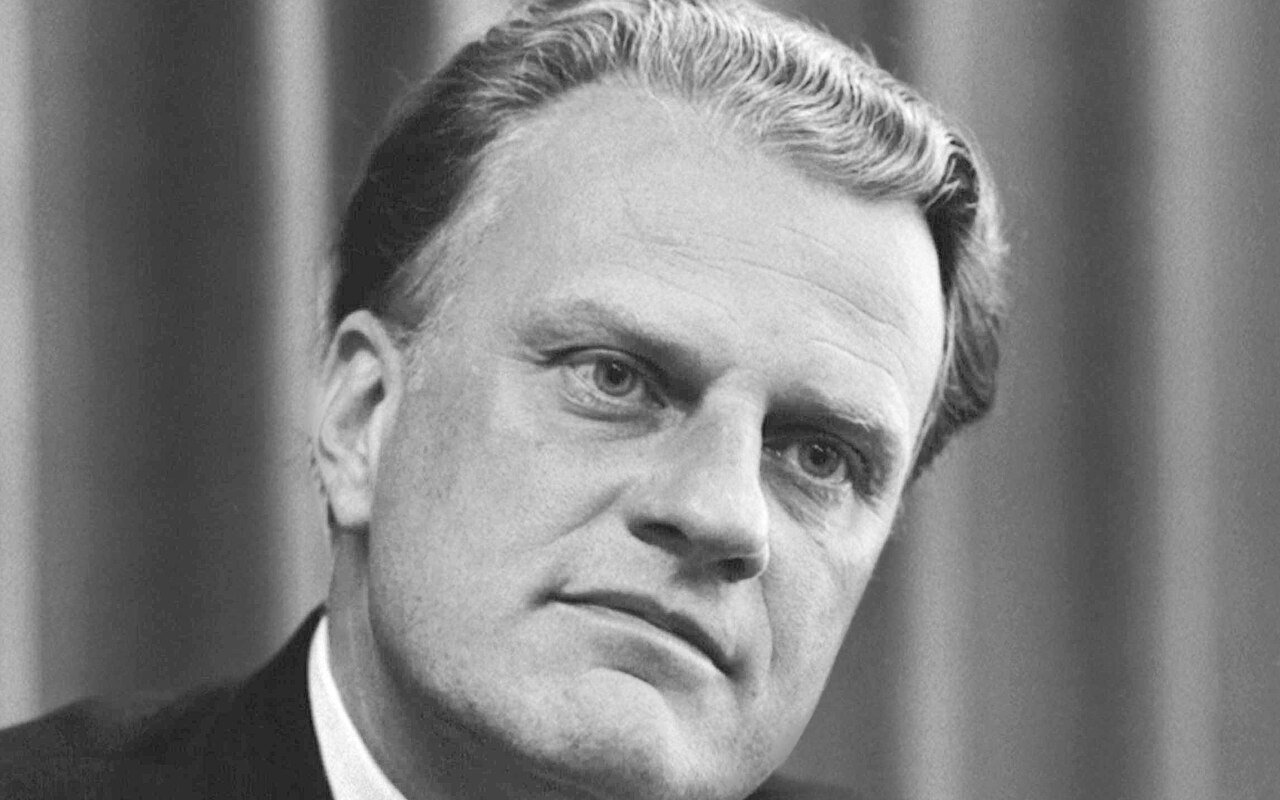
Picture: Billy Graham in 1966. Library of Congress, public domain.
The farm boy and the travelling preacher
Billy Graham was the eldest of four children on a 300-acre dairy farm. His parents were Presbyterians of the reformed, strict kind, and he was bored by church. In the autumn of 1934 an evangelist called Mordecai Ham held eleven weeks of meetings in Charlotte, and Billy, sixteen, went to see what the fuss was about. On one of the last nights, with the choir singing "Just As I Am", he walked forward. He said later there were no tears and no lightning. "I simply felt at peace," he wrote. The hymn became the one sung at the end of every crusade he ever held, and the title of his autobiography.
He went to Bob Jones College and lasted a semester. Then to the Florida Bible Institute near Tampa, where he practised sermons on the cypress stumps along the Hillsborough River and preached his first ones in trailer parks and small Baptist churches. He was ordained a Southern Baptist minister in 1939. At Wheaton College in Illinois, where he finished a degree in anthropology in 1943, he met Ruth Bell, the daughter of a missionary surgeon, who had grown up in China and intended to go to Tibet as a missionary. She married him instead, in August 1943, and told him plainly that God had called him to preach and that she would make the home. They had five children and were married for sixty-three years.
Los Angeles, 1949: "Puff Graham"
Graham spent the late 1940s with Youth for Christ, preaching to crowds of servicemen and teenagers across America and, in 1946, in bombed-out Britain. The turning point came in Los Angeles in September 1949. A tent called the Canvas Cathedral went up on a downtown lot for a three-week campaign. A few well-known converts, a radio star and an Olympic runner among them, caught the attention of the newspaper magnate William Randolph Hearst, who is said to have sent his editors a two-word telegram: "Puff Graham." The campaign ran for eight weeks. Three hundred and fifty thousand people came. Billy Graham was thirty, and famous.
A year earlier, in a hotel room in Modesto, California, he and his team had already decided what fame would not do to them. They wrote down the things that had destroyed evangelists before them: money, women, criticism of the local church, and exaggerated numbers. From then on Graham never handled the offerings, took a fixed salary, never met or travelled alone with a woman other than his wife, worked with local churches rather than against them, and reported attendance by the police estimates, not his own. The "Modesto Manifesto" is still the standard by which travelling ministries are measured, and the reason that in seventy years of public life no scandal of money or morals ever attached to his name.
London, New York, Seoul
In 1954 Graham hired the Harringay Arena in north London for a month and stayed for twelve weeks. Two million people came, and he preached to another 120,000 at Wembley on the last day in the rain. In 1957 he filled Madison Square Garden in New York for sixteen weeks. That year he invited Martin Luther King Jr to pray at the Garden, and he had already, in Chattanooga in 1953, walked down and pulled up the ropes that separated black and white seating with his own hands, telling the ushers to leave them down. He refused to preach in South Africa until 1973, when the authorities agreed to let him preach to an integrated crowd in Durban.
In June 1973, on Yoido Plaza in Seoul, more than a million people stood to hear him on a single afternoon. It remains the largest in-person audience of his ministry, and probably of any preacher in history. He preached in the Soviet Union in 1982 and in North Korea in 1992 and 1994, and was criticised for both. He answered that he would go anywhere he was allowed to preach Christ.
Africa, 1960
In 1960, the year seventeen African countries became independent, Graham spent ten weeks on the continent, preaching in eleven countries from Liberia and Ghana to Kenya, Ethiopia and Egypt, and then in Jordan and Israel. More than half a million people heard him. The largest crowds were in Nigeria, where he preached in Lagos, Ibadan, Enugu, Kaduna and Jos between 28 January and 12 February. Time magazine reported crowds in Lagos of up to 100,000 and nearly 2,000 people walking forward on a single night. At University College, Ibadan, he spoke to students in the open air and several hundred responded. In Enugu the estimate was 40,000. The Billy Graham Library puts the attendance in Nigeria at more than 200,000, with about 5,000 recorded decisions for Christ.
He met opposition too. Muslim organisations in Lagos printed pamphlets against the preaching, and a request to meet Muslim leaders was turned down. Graham preached the same message he preached everywhere, and left the local churches to disciple the thousands who had come forward. Some of the men and women who later built Africa's great churches were young believers or children in those crowds. He had refused to include South Africa, because the government would not let him preach to a mixed audience, and he said so publicly. The tour's lasting mark was not the numbers but the method: one text, John 3:16, an altar call, and the converts handed to the churches.
The Bible says
Graham's preaching was not clever. He said so himself. Early in his ministry, in 1949, he had gone through a crisis of doubt about the Bible, prompted by a friend who had abandoned belief in its authority. One night at a retreat centre in the San Bernardino mountains he laid his Bible on a tree stump and prayed, in effect, that he could not answer every question but would accept the book as God's word by faith. He said everything that followed in Los Angeles flowed from that night. From then on his sermons were stitched together with one phrase, repeated like a hammer: "The Bible says."
The message was always the same, and he refused to let it be more complicated. God loves you. You are a sinner and cannot save yourself. Christ died for your sins and rose again. You must repent and receive him, now, tonight. Then the choir would sing "Just As I Am" and he would stand and wait, with his chin on his fist, while people came. He preached to kings and to prisoners in exactly the same words.
Presidents and the one mistake he owned
Graham knew every American president from Harry Truman to Barack Obama, and prayed with most of them. He was closest to Richard Nixon, and that friendship was his great public regret. In 2002 tapes from 1972 were released in which he was heard agreeing with Nixon's remarks about Jewish influence in the media. Graham, by then eighty-three, said he had no memory of it, did not believe it, and was ashamed of it. He apologised publicly and in person to Jewish leaders. He also said that he had been too close to political power, and warned younger evangelists to stay out of partisan politics. "I have one message," he said. He had learned, late, how easily that message could be borrowed.
Homegoing
Ruth died in 2007. Billy Graham died at home in Montreat, North Carolina, on 21 February 2018, aged ninety-nine. His body lay in honour in the rotunda of the United States Capitol, only the fourth private citizen so treated. He was buried beside Ruth at the Billy Graham Library in Charlotte, in a plain plywood coffin made by prisoners at Angola penitentiary in Louisiana, under a stone that reads "Preacher of the Gospel of Jesus Christ."
He had written his own announcement years before. "Someday you will read or hear that Billy Graham is dead. Don't you believe a word of it. I shall be more alive than I am now. I will just have changed my address. I have gone into the presence of God."
What a believer today can take from Billy Graham
- One message, kept simple. He never grew out of John 3:16. Neither should the church.
- Rules before the test, not after. Modesto was written before the money came. Every ministry that wants to last should write its own.
- The gospel is for everyone in the same room. He pulled down the ropes in 1953 and would not preach to a segregated crowd. Any church divided by race, tribe, tongue or class should hear that.
- Keep the pulpit out of the party. His regret over Nixon is a warning to every preacher courted by a politician.
- Leave the glory. "My one purpose in life," he said, "is to help people find a personal relationship with God, which, I believe, comes through knowing Christ."
This article is part of God's Generals, our series on the men and women who carried the gospel in their generation. Related: The Apostle Thomas in Kerala, and our Teaching section.
Questions this article answers
When was Billy Graham born and when did he die?
Billy Graham was born on 7 November 1918 on a dairy farm near Charlotte, North Carolina, and died at his home in Montreat, North Carolina on 21 February 2018, aged ninety-nine. He is buried beside his wife Ruth at the Billy Graham Library in Charlotte.
Did Billy Graham preach in Africa?
Yes. In early 1960 he toured eleven African countries, from Liberia and Ghana to Kenya, Ethiopia and Egypt, and more than half a million people heard him. The largest meetings were in Nigeria, where Time magazine reported Lagos crowds of up to 100,000 and the Billy Graham Library counts more than 200,000 people and about 5,000 decisions for Christ.
How many people did Billy Graham preach to?
The Billy Graham Evangelistic Association counts about 215 million people who heard him in person in 185 countries and territories, with more than three million recorded decisions for Christ. His largest single crowd was over a million people on Yoido Plaza in Seoul in June 1973.
What was the Modesto Manifesto?
In 1948 Graham and his team wrote down the four things that had wrecked evangelists before them, money, sexual immorality, criticism of local churches and inflated numbers, and set rules against each. Graham took a fixed salary, never travelled or met alone with a woman other than his wife, worked with local churches and used police crowd estimates. The rules held for seventy years.
What was Billy Graham's message?
The same every night: God loves you, you are a sinner who cannot save yourself, Christ died for your sins and rose again, and you must repent and receive him now. He anchored every sermon with the phrase "the Bible says" and closed with the hymn "Just As I Am".