Thomas answered him, "My Lord and my God!" (John 20:28)
Ask an Indian Christian from Kerala where their church came from and you will not hear about missionaries. You will hear a date: AD 52. In that year, the tradition says, the Apostle Thomas, the one who would not believe until he had put his finger in the wounds, stepped off a trading ship at Muziris on the Malabar coast and began to preach. Twenty years later he died on a hill near what is now Chennai, a spear in his side. The Christians of Kerala, six million of them today, call themselves Mar Thoma Nasranis, the Nazarenes of St Thomas, and they are, by their own account, the oldest church in Asia outside the Holy Land.
This article tells the story as the Thomas Christians tell it, weighs what historians can and cannot confirm, follows the church through the Persian, Portuguese and Pentecostal centuries, and asks what the rest of the Church should make of the apostle who doubted, and then went furthest.
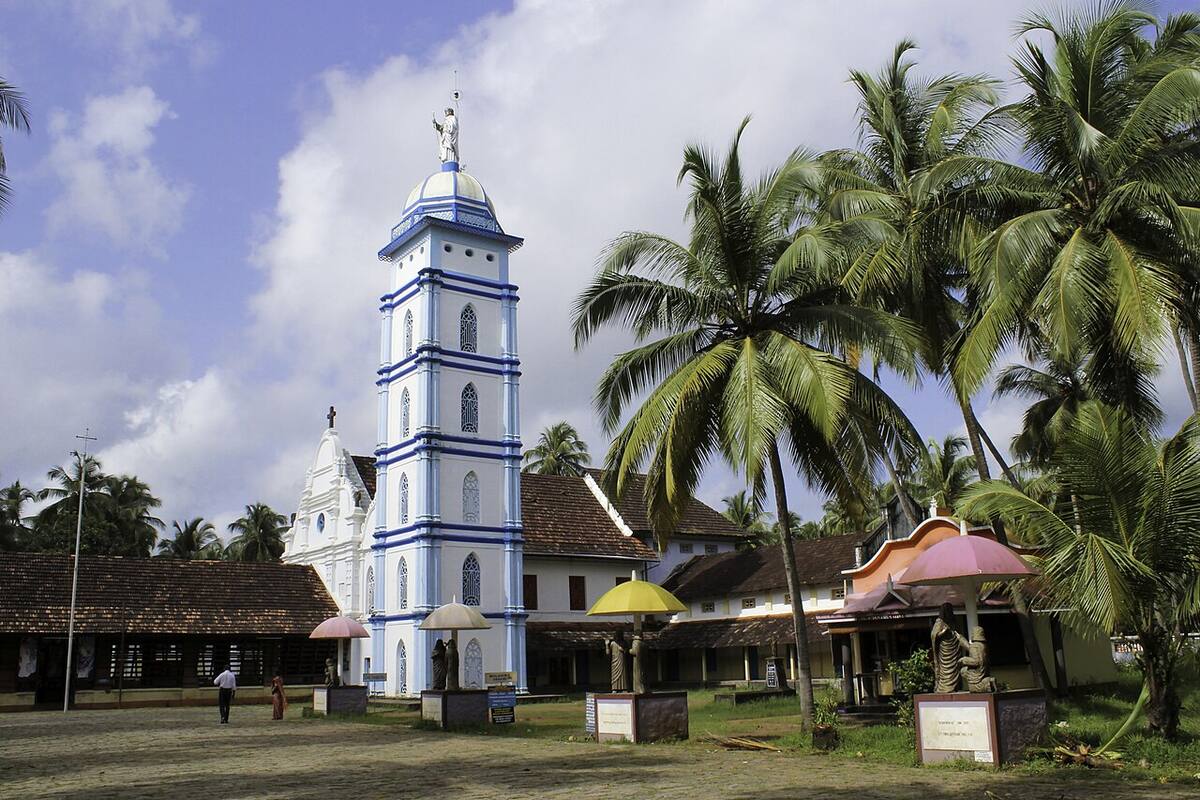
Picture: St Thomas Syro-Malabar Church, Palayur, one of the seven churches the apostle is said to have founded. Via Wikimedia Commons.
The story the Thomas Christians tell
The Malabar coast in the first century was not the end of the world. It was the pepper coast, and the pepper went to Rome. Pliny complained about the gold draining east to pay for it; the Periplus of the Erythraean Sea, a Greek shipping guide of about AD 60, lists Muziris as the great port of the region; and Roman coins, amphorae and tableware have come out of the ground at Pattanam, near Kodungallur, where nine seasons of excavation between 2007 and 2015 found Mediterranean trade goods from exactly this period. A Jewish community was already settled there. A Galilean Jew with a message could board a ship at Alexandria or the Red Sea ports and reach Malabar on the monsoon in a matter of weeks. Nothing about the journey was impossible.
The tradition says Thomas made it in AD 52, landed at Maliankara near Muziris, and preached first to the Jewish settlement and then to the Hindu families of the coast, among them Brahmins of Palayur, who received baptism. Over the next twenty years he is said to have founded seven churches, the ezharappallikal, "seven and a half churches": Kodungallur, Palayur, Kottakkavu (North Paravur), Kokkamangalam, Niranam, Nilackal and Kollam, with a "half" church at Thiruvithamcode in what is now Tamil Nadu. He then crossed to the east coast, to the Chola kingdom, and preached at Mylapore. There, in AD 72, the tradition says, he was killed with a spear on a hill above the town, now called St Thomas Mount, and buried by his disciples at Mylapore, where a church was raised over the grave.
The fullest telling is the Thomma Parvam, the Song of Thomas, a Malayalam ballad written down in 1601 but understood as the summary of a much older oral tradition, sung at weddings and feasts for centuries.
What the evidence says
Honest Christians should want to know what can be shown and what must be believed, and here the picture is clearer than sceptics suggest and less tidy than the tradition would like.
The earliest written source is the Acts of Thomas, composed in Syriac, probably at Edessa, in the early third century. It sends Thomas to India as a carpenter sold into the service of a king named Gundaphar, has him build the king a "palace in heaven" by giving the building money to the poor, and ends with his martyrdom by spearmen at the order of another king. The Acts are a romance, full of miracles and the ascetic theology of their Syriac authors, and no one treats them as a chronicle. But for eighteen centuries their King Gundaphar was taken to be invention, until coins and then an inscription at Takht-i-Bahi, in what is now Pakistan, showed that Gondophares was a real Indo-Parthian king ruling in the north-west of the subcontinent in the first half of the first century, exactly when the Acts put Thomas there. The romance had a real king in it. That does not prove Thomas met him, but it means the story was attached to real history from the beginning.
The Church Fathers took it for granted. Eusebius, writing about 325, preserved Origen's statement from a century earlier that when the apostles divided the world, Thomas received Parthia. Eusebius also recorded that Pantaenus, the head of the catechetical school at Alexandria, travelled to "India" about AD 180 and found Christians already there, with a Hebrew Gospel of Matthew they said Bartholomew had left them. Ephrem the Syrian, who died in 373, sang of Thomas as the apostle of India and of his bones being brought from India to Edessa, where the Chronicle of Edessa records a shrine to him by 394. Gregory of Tours in the sixth century knew of the tomb in India and the shrine in Edessa; and Cosmas Indicopleustes, an Alexandrian merchant who sailed the Indian Ocean about 522, reported Christians with a bishop from Persia on the Malabar coast and in Ceylon. By the time anyone wrote the Malabar tradition down, then, the Christian world had believed for three centuries that Thomas went to India and died there, and had known for four centuries that there was a church on the Malabar coast.
The tomb. Marco Polo visited the grave at Mylapore in the 1290s and described Christians and Muslims alike venerating it. The Portuguese reached it in 1517, opened it in 1523, and found bones and, by their account, the head of a lance; the present cathedral basilica of San Thome stands over the site, one of only three churches in the world built over the tomb of an apostle. Part of the relics had long since gone to Edessa, and from there, in 1258, to Ortona in Italy, where they remain.
What cannot be shown. No first-century document places Thomas in Kerala rather than the north-west, and the specific date of AD 52, the seven churches and the Brahmin converts rest on the Malabar tradition alone. Some historians think the first Christians of Malabar were merchants from Persia rather than converts of an apostle, and that the Thomas story travelled to them with the Syriac liturgy. Pope Benedict XVI said in 2006 that Thomas "first evangelised Syria and Persia, then went on to western India, from where Christianity also reached southern India", a careful sentence that provoked protest in Kerala and was amended. The strongest single argument on the tradition's side is the one Kerala's Christians have always made: a church this old, with a Syriac liturgy, a Jewish-Christian substratum, a tomb venerated across religions and a memory this stubborn, does not come from nowhere, and nobody has proposed a better founder.
The church Thomas left: Persian, Portuguese, divided
For its first fifteen centuries the church of the Thomas Christians looked east, not west. Its bishops came from the Church of the East in Persia, its liturgy was in Syriac, and a second migration, led by the merchant Thomas of Cana in the fourth century, left the community its Knanaya branch. It lived at peace inside Hindu Kerala, with the rank of a high caste and privileges granted by local kings on copper plates that still survive.
Then the Portuguese arrived. Vasco da Gama reached Calicut in 1498, and within a century the Archbishop of Goa, Aleixo de Menezes, had convened the Synod of Diamper in 1599 to bring the Thomas Christians under Rome and the Latin rite, burning Syriac books, replacing Persian bishops and Latinising the liturgy. The community bore it for half a century. On 3 January 1653, at Mattancherry near Cochin, thousands of Thomas Christians tied ropes to a stone cross and, holding the ropes, swore the Coonan Cross Oath never again to submit to the Portuguese. The church split: those who returned to communion with Rome became the Syro-Malabar Church; those who held out, under Mar Thoma I, became the Malankara Church, which later divided again into the Malankara Orthodox and Jacobite churches, and in the nineteenth century produced the reformed Mar Thoma Syrian Church under Anglican influence, and in 1930 the Syro-Malankara Catholics who returned to Rome.
The result is a Christian community unlike any other. Kerala's 6.1 million Christians, 18 per cent of the state, are divided among the Syro-Malabar Church, the largest with some 2.35 million in the state; the Malankara Orthodox and Jacobite Syrian churches; the Syro-Malankara Catholics; the Mar Thoma Church; the Latin Catholics evangelised by the Portuguese; the Church of South India; and the Pentecostals. All but the last two trace themselves to Thomas, and all of them keep 3 July, the day his relics were moved to Edessa, as his feast. Since 2021 Christians across India have kept it as Indian Christian Day.
Pentecost comes to Thomas's coast
Readers of this site will want the last chapter. Pentecostal teaching reached Kerala in 1909 through the American evangelist George Berg, and the first congregation was formed in 1911. Robert F. Cook, another American, planted a church at Thuvayoor in 1914 and gave his life to the Dalits the Syrian churches had kept at arm's length. In 1923 a young Syrian Christian teacher, K. E. Abraham, was baptised in the Holy Spirit; convinced that an Indian church should not run on foreign money, he parted from Cook in 1930 and founded what became the India Pentecostal Church of God, now one of the largest Pentecostal bodies in the country. The Assemblies of God, the Church of God (Full Gospel) and The Pentecostal Mission followed, and Kerala's Pentecostals, about 4 per cent of its Christians, have sent pastors and congregations to the Gulf, Europe, North America and Australia in numbers out of all proportion to their size. The apostle who brought the gospel by sea has descendants who carry it back out the same way.
What the rest of us should learn from Thomas
Thomas is remembered for one bad evening (John 20:24-25) and not for the twenty years that followed. The man who said "unless I see" was also the man who said, when Jesus proposed walking into Judea to die, "Let us also go, that we may die with him" (John 11:16), and who asked the question that drew out the answer the whole world needed: "Lord, we do not know where you are going. How can we know the way?" "I am the way, and the truth, and the life" (John 14:5-6). Doubt that is honest, and brought to Jesus, ends in the fullest confession in the Gospels: "My Lord and my God."
And then it ends in India. Whatever the historians settle, the Church has believed since the third century that the apostle who needed to touch the wounds went further from Jerusalem than any of the Twelve, preached to Jews, Parthians and Hindus, and died for it with his back to the sea that had carried him. "Go therefore and make disciples of all nations" (Matthew 28:19) was not a figure of speech to him. The Christians of Kerala have kept his name for two thousand years under Persian bishops, Portuguese archbishops, Hindu kings and, now, a government that watches conversion closely. They are proof that the gospel took root in Asia before it reached most of Europe, and a rebuke to anyone who still calls Christianity a Western religion.
For the apostles' other journeys and the faith once delivered, see our Teaching and Apologetics sections.
Questions this article answers
Did the Apostle Thomas really go to India?
The Christian world has believed so since the early third century, when the Acts of Thomas placed him at the court of the Indo-Parthian king Gondophares, a ruler later confirmed by coins and an inscription. Origen, Eusebius, Ephrem and Gregory of Tours all record Thomas as the apostle of India, and his tomb at Mylapore was venerated by the time Marco Polo saw it in the 1290s. No first-century document survives, and some historians think Malabar's first Christians were Persian merchants, but no better founder has been proposed.
When did St Thomas arrive in Kerala?
The Kerala tradition says AD 52, at Muziris, the Roman-era pepper port near Kodungallur whose remains have been excavated at Pattanam. The date comes from the Malabar tradition itself, written down in the Thomma Parvam in 1601, not from any first-century source.
What are the seven churches of St Thomas?
Kodungallur, Palayur, Kottakkavu (North Paravur), Kokkamangalam, Niranam, Nilackal and Kollam, with a "half" church at Thiruvithamcode. Churches still stand on most of the sites, though not the original buildings.
How did the Apostle Thomas die?
By tradition he was speared on a hill near Mylapore, now St Thomas Mount in Chennai, in AD 72, and buried at Mylapore, where San Thome Basilica now stands over the tomb. Some of his relics were taken to Edessa in the third or fourth century and in 1258 to Ortona, Italy.
Who are the Saint Thomas Christians?
The Christians of Kerala who trace their church to the apostle: today the Syro-Malabar and Syro-Malankara Catholics, the Malankara Orthodox and Jacobite Syrian churches, the Mar Thoma Syrian Church and the Chaldean Syrian Church, about 12 per cent of Kerala's people. Their liturgy was Syriac and their bishops came from Persia until the Portuguese arrived.
What was the Coonan Cross Oath?
On 3 January 1653 thousands of Thomas Christians at Mattancherry swore, holding ropes tied to a stone cross, never again to accept Portuguese church rule, after the Synod of Diamper of 1599 had Latinised their church. It split the community into those who later returned to Rome and those who became the Malankara churches.
How many Christians are there in Kerala?
About 6.1 million at the 2011 census, 18 per cent of the state, the highest share of any large Indian state. Roughly 4 per cent of them are Pentecostal, in churches such as the India Pentecostal Church of God, the Assemblies of God and The Pentecostal Mission.
Sources: the Acts of Thomas; Eusebius, Ecclesiastical History 3.1 and 5.10; Ephrem, Carmina Nisibena 42; the Chronicle of Edessa; Cosmas Indicopleustes, Christian Topography; Marco Polo, Travels; the Thomma Parvam (1601); Encyclopaedia Britannica, "Thomas Christians"; the Kerala Council for Historical Research and Outlook India on the Pattanam excavations (2007-2015); Baselius College, Kottayam, "Historical Study of the Arrival of Apostle St Thomas in Kerala"; Pius Malekandathil on the seven churches; the Malankara Orthodox Syrian Church and Syro-Malabar Church histories; Nasrani.net on the early references; the Indian census of 2011 via "Christianity in Kerala"; histories of Pentecostalism in Kerala (George Berg, Robert F. Cook, K. E. Abraham and the India Pentecostal Church of God); Pope Benedict XVI's general audience of 27 September 2006.