He changes times and seasons; he removes kings and sets up kings. (Daniel 2:21)
Americans voted on Tuesday 3 November 2026 and handed both houses of Congress to the Democrats, two years after giving Donald Trump a second term with a Republican Senate and House. The Associated Press called the Senate for the Democrats just before midnight on election night and the House at 1.24 am on Wednesday. Democrats also took the governorships of Texas, Georgia, Ohio, Nevada and Iowa. Hakeem Jeffries, who will be the first Black Speaker of the House, called it "an American tsunami"; Vice-President J.D. Vance said simply: "The reason we lost is the war."
This article gives the results as they stand on Wednesday night, with Alaska, Mississippi and dozens of House seats still being counted, then the exit polls, including how Christians voted, then the ballot measures on abortion and marriage, and finally what a Democratic Congress means for two things this site follows closely: the persecution of Christians in Nigeria, and America's relationship with Israel.
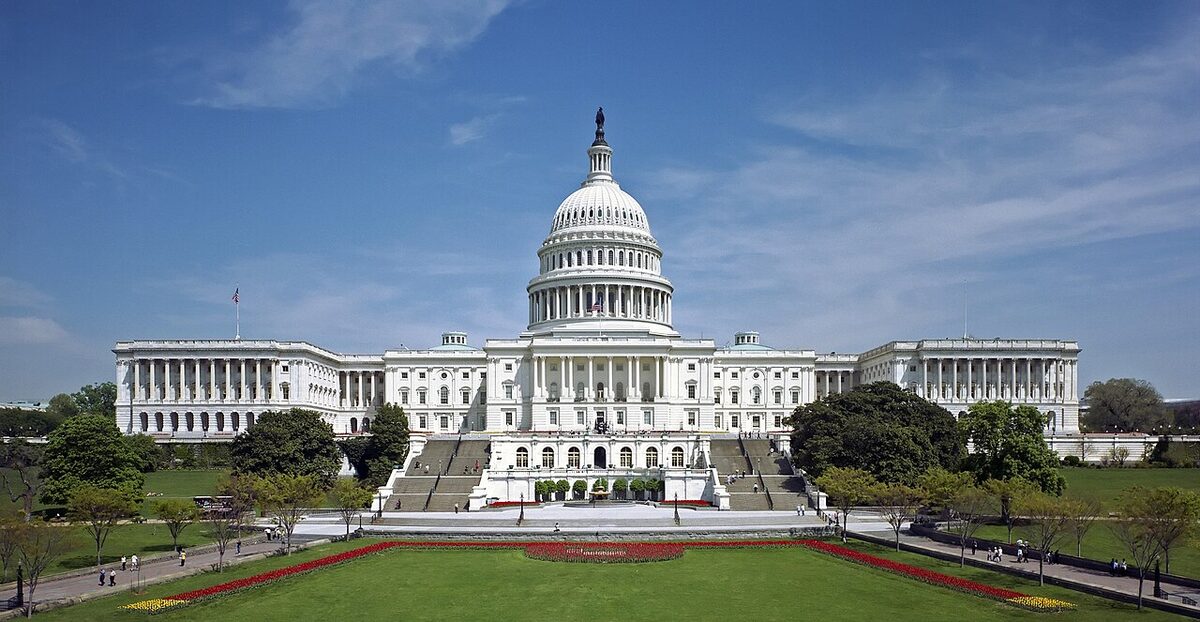
Picture: the United States Capitol, west front. Public domain.
The Senate: seven seats flipped, two still counting
Republicans went into the night with 53 seats to 47 and the Democrats needed a net gain of four. They gained seven, with two more races on a knife edge. NBC's count on Wednesday night stood at 54 Democrats to 44 Republicans.
| State | Result |
|---|---|
| Texas | James Talarico (D) beat Ken Paxton (R), 55 to 43; the first Democrat to win statewide in Texas in 32 years. Paxton conceded |
| Ohio | Sherrod Brown (D) took back his old seat from Jon Husted (R), 50 to 45 |
| Maine | Troy Jackson (D) unseated Susan Collins (R), 53 to 47; she conceded. The first Democratic Senate win in Maine since 1988 |
| North Carolina | Roy Cooper (D) beat Michael Whatley (R) for the open seat, 59 to 39 |
| Iowa | Josh Turek (D) beat Ashley Hinson (R) for the open seat, 50.5 to 46.4; the call that clinched the majority |
| Kansas | Adam Hamilton (D), a Methodist megachurch pastor, unseated Roger Marshall (R), 51 to 46; the first Democratic Senate win in Kansas since 1932 |
| South Carolina | Annie Andrews (D), a paediatrician, beat Senator Darline Graham (R), 51 to 47. Graham was appointed to the seat after her brother Lindsey Graham died in July |
| Michigan | Abdul El-Sayed (D) held the open seat against Mike Rogers (R), 52.5 to 45.5 |
| Georgia | Jon Ossoff (D) re-elected over Mike Collins (R), about 59 per cent |
| New Hampshire | Chris Pappas (D) held the open seat against Chris Sununu (R) |
| Florida | Ashley Moody (R) held |
| Alaska | Too close to call: Mary Peltola (D) led Dan Sullivan (R) by 626 votes on Wednesday morning with many absentee ballots outstanding; neither has 50 per cent, so the ranked-choice count on 18 November decides it |
| Mississippi | Too close to call: Scott Colom (D) led Cindy Hyde-Smith (R) by 28 votes out of more than 925,000 at midnight, with thousands of affidavit and absentee ballots still to be processed |
Texas and Kansas sending Democrats to the Senate, Maine and South Carolina turning out two Republican senators, and Mississippi, which Trump won by more than twenty points two years ago, coming down to a few dozen votes: that is the measure of the night. If Peltola and Colom both hold their leads the Democrats finish at 56.
The House: Jeffries in line to be Speaker, Johnson steps back
Democrats needed a net gain of three seats. By Wednesday night NBC had called 242 seats for them to 150 for the Republicans with 43 still open, and its decision desk projected the Democrats would finish with at least 258 of 435, an 81-seat majority; other desks put the floor between 245 and 250. Among the defeated Republicans were Mike Lawler in New York, Brian Fitzpatrick in Pennsylvania, Juan Ciscomani in Arizona, Victoria Spartz in Indiana and Tom Barrett in Michigan, and Democrats took seats in Nebraska, North Carolina and Wisconsin, several of them redrawn by Republican legislatures to stay Republican. In Florida one seat is within half a point and heading for a recount.
Hakeem Jeffries of New York announced on Wednesday that he will run for Speaker when the new Congress meets in January. "It wasn't simply a blue wave," he said. "It was an American tsunami." He called the result "a stunning rebuke of MAGA extremism" and said Democrats would focus "not on retribution" but on the prices of groceries, petrol, housing and health care: "We ran on affordability, we won decisively on affordability." Speaker Mike Johnson, who held his own Louisiana seat, said Republicans were "disappointed" but "never discouraged" and would retake the House in 2028, then told his staff on Wednesday morning that he will not run for minority leader. Steve Scalise and Jim Jordan are already contesting the job.
The governors: five flips, Texas among them
The night's second shock was in the statehouses. Gina Hinojosa (D) unseated Governor Greg Abbott of Texas, 53 to 46, the first Democratic governor there since Ann Richards; Abbott conceded. Keisha Lance Bottoms (D) won Georgia, the first Black woman elected governor of any state. Amy Acton (D) beat Vivek Ramaswamy (R) in Ohio, Aaron Ford (D) unseated Joe Lombardo (R) in Nevada, and Rob Sand (D) won Iowa. Democrats held Pennsylvania (Josh Shapiro), Arizona (Katie Hobbs), Michigan (Jocelyn Benson), Wisconsin (David Crowley), Minnesota (Amy Klobuchar, the state's first woman governor), Illinois (J.B. Pritzker), New York (Kathy Hochul) and California (Xavier Becerra). Republicans held Florida, where Byron Donalds edged David Jolly, and New Hampshire. Kansas is uncalled, with the Democrat Cindy Holscher about 5,500 votes ahead and a hand-count audit under way.
What the voters said
The networks' exit poll put the president's approval among those who voted at 38 per cent against 62 disapproving, the worst for any president at a midterm since such polls began. About 60 per cent said he was a factor in their vote; 43 per cent said one reason for their vote was to oppose him. The economy was the first concern of 39 per cent and "the state of democracy" of a third; 65 per cent said the president's policies had made the economy worse and 62 per cent held him responsible for high prices. Immigration was the only issue on which voters preferred the Republicans, and 57 per cent said enforcement had "gone too far". The Associated Press's own voter poll found the same: two thirds saying his policies had hurt the economy, with tariffs, the war with Iran and the unkept promise to lower prices the reasons given, and only a third of Hispanic voters backing Republican candidates, against four in ten who voted for Trump in 2024.
What Trump and Vance said
The president's first reaction, as the returns came in, was to turn on Fox News and one of its hosts. Then, at 10.37 pm, on Truth Social: "I wasn't on the Ballot and if I was, we would have won IN A LANDSLIDE!" and, a little later, "I'm going to become a Political Pundit, both good and bad, on the reasons these Candidates won and lost!" To Bret Baier he blamed weak candidates, low enthusiasm and petrol prices, and said he was willing to accept the results. On Wednesday, at the site of the new White House ballroom, he did not mention the election until reporters asked, and then conceded the point his vice-president had made that morning. Asked whether Vance was right that the war with Iran had cost the Republicans the election, he said: "I think it's largely true." He added: "If I had it to do again I'd have to do it again, because long-term it's the only answer." The White House's official account posted a "PSA": "Trump is still your president."
Vance's post was the most remarkable statement of the day from either party. "The reason we lost is the war," he wrote. "Many people who voted for Trump/Vance in 2024 voted for Democrats in 2026." And: "To the people who are p---ed off and want to say, 'I told you so': you're right, you did tell us so." Donald Trump Jr. replied: "Every word of this is 💯💯💯." Senate Republican leader John Thune said his caucus "will not stand idly by as the far-left, socialist wing of the Democrat Party attempts to unwind everything we've done": "Thankfully, we still have President Trump in the White House." Chuck Schumer, who expects to be majority leader, said: "The days of Trump's supplicant Senate are over," and promised to "launch investigations, take him to court and entangle him in legislative razor wire" whenever the president defies the law.
How Christians voted
The exit polls now give the picture, and it is not the one either side expected. White evangelicals voted Republican by 82 per cent to 17, almost exactly their 83 per cent of 2022. What changed was how many of them turned up. They were 17 per cent of the electorate, against about a quarter in every midterm and presidential election for more than a decade. Protestants and other Christians as a whole, 40 per cent of voters, went Republican 59 to 40. Catholics, a fifth of voters, split 50 to 49 for the Democrats, with white Catholics 56 per cent Republican and Hispanic Catholics heavily Democratic. Voters with no religion, now the largest single religious category in the electorate, voted Democratic by 78 per cent.
In other words the evangelicals who voted stayed loyal, and the Republican coalition failed because fewer of them came and everyone else moved. Pew had seen it coming: the president's approval among white evangelicals fell from 78 per cent in January 2025 to 58 per cent this autumn, and NPR found only 61 per cent "very enthusiastic" about voting. Sean Feucht's verdict was blunt: "The church stayed home." Tony Perkins of the Family Research Council reminded believers that the country still offers "unparalleled freedom that Christians can use for the advancement of the Kingdom", and the Billy Graham Evangelistic Association's magazine said Christians were "surprised but not discouraged".
The other religious story of the night was on the Democratic side. At least five progressive clergy or church-rooted candidates won in Republican states, led by Adam Hamilton, the pastor of the largest United Methodist congregation in America, who is now a senator for Kansas, and James Talarico, a Presbyterian seminarian whose pastor said "there's an awakening taking place." The historian John Fea wrote that Trump-aligned evangelical leaders "won't have the moral credibility to persuade" after this.
The ballot measures: abortion, marriage and girls' sport
Voters in 39 states decided 145 measures. Abortion rights won in three of four states: Virginia and Nevada wrote a right to abortion into their constitutions, by 62 and 63 per cent; Missouri rejected, 55 to 45, an amendment that would have repealed the abortion rights voters approved in 2024; Idaho rejected a rights measure, 56 to 44. Virginia also voted, 57 to 43, to repeal its constitutional ban on same-sex marriage, so that marriage would stay legal there even if the Supreme Court overturned Obergefell. On the other side of the ledger, measures protecting girls' sport from transgender participation passed or were leading everywhere they appeared: Arizona at 59 per cent, Nebraska, Washington at 57 per cent, and Colorado narrowly. Voter identification was written into the constitutions of Ohio, North Carolina and Nevada, and Kansas and Alaska approved citizenship-only voting. Massachusetts refused, three to one, to repeal legal cannabis sales. No school-choice measure reached any ballot.
What it means for Nigeria's Christians
The American pressure on Nigeria over the killing of Christians, which this site reported last week, has been a Republican project: Senator Ted Cruz's bill, Congresswoman Nancy Mace's campaign, Chris Smith's Nigeria Religious Freedom and Accountability Act, Riley Moore's amendment barring funds to the Nigerian government, which passed the House 217 to 209 in July without Senate or White House backing, and President Trump's designation of Nigeria as a Country of Particular Concern on 31 October 2025, followed by the Christmas Day strikes on Islamic State positions.
The designation and the military cooperation are the executive's and do not change with Congress; the State Department's annual review of the designation falls this month, and Moore said days before the election that "we absolutely cannot remove the CPC designation from Nigeria while radical Islamic terrorists continue this horrific violence against Christians." The legislation does change hands. Smith chairs the House Africa subcommittee; in January a Democrat will. Religious freedom abroad has long had bipartisan support in Congress, and ICIR, the Nigerian investigative outlet, expects it to "remain prominent in congressional discussions about Nigeria". But no Democrat has yet said what they will do with Smith's bill or Moore's amendment, and the press has mostly filed the subject under Republican culture war. Christians who want the pressure kept up now have Democratic members to write to as well as Republican ones.
What it means for Israel
The campaign's last word on Israel came from the president himself. On Fox on election morning he said he and Netanyahu had agreed that the United States would stop its 4 billion dollars a year in military aid after this year while continuing to sell Israel weapons, because Israel "no longer needed" it and the aid had become "a bad talking point" for Democrats "like an El-Sayed". Congress appropriates that money, no detail has followed, and Israeli analysts called it an election-day gambit; Gadi Eisenkot, who may be Israel's next prime minister, replied that the "special relationship with the United States is a key component in its national security."
The two men who will run Congress, Hakeem Jeffries and Chuck Schumer, are lifelong supporters of Israel; Schumer was one of only seven Senate Democrats who voted in April against resolutions to block arms sales to it, and Jeffries voted in July against ending military aid when almost half his caucus voted the other way. But they lead a party that has moved: two thirds of Democratic voters oppose more military aid, the Block the Bombs bill has well over a hundred cosponsors, Ro Khanna says "zero aid" will be part of the Democratic agenda, and Michigan's new senator said during the campaign that Israel is "not an ally". The next ten-year aid agreement, if there is one, falls to this Congress. In Israel, Yair Lapid said the result "eliminates any possibility of a unity government led by Netanyahu" and that "Israel cannot afford" for him to remain, and Yair Golan said it showed "just how toxic Netanyahu is among both Democrats and Republicans". Netanyahu himself has said nothing about it. Israel's own post-election deadlock, which we are following here, means the two democracies most bound to each other both begin a winter of coalition arithmetic.
How a Christian should read it
Scripture is clear about who sets up and removes rulers (Daniel 2:21; Psalm 75:6-7), and equally clear about what believers owe the rulers they get: "supplications, prayers, intercessions, and thanksgivings... for kings and all who are in high positions, that we may lead a peaceful and quiet life, godly and dignified in every way" (1 Timothy 2:1-2). Paul wrote that under Nero. It covers a Democratic Congress and a Republican president, and it covers the Christians who voted for each.
So pray for the new Congress and for the president who must work with it; for the persecuted in Nigeria, that their cause does not become a casualty of Washington's change of hands; for Israel and for the peace of Jerusalem; and for the American church, whose witness depends less on who won on Tuesday than on how it treats those who lost. "Put not your trust in princes" (Psalm 146:3) was never a counsel of despair. It is a reminder of where the trust goes.
For more current events read in the light of Scripture, see our Prophecy in the News and News sections.
Questions this article answers
Who won the 2026 US midterm elections?
The Democrats. They won the Senate, 54 seats to 44 with Alaska and Mississippi still counting, flipping seven Republican seats, and the House, where NBC projects at least 258 of 435 seats. They also won the governorships of Texas, Georgia, Ohio, Nevada and Iowa. Hakeem Jeffries will stand for Speaker in January.
Which Senate seats flipped in 2026?
Texas (James Talarico over Ken Paxton), Ohio (Sherrod Brown over Jon Husted), Maine (Troy Jackson over Susan Collins), North Carolina (Roy Cooper), Iowa (Josh Turek), Kansas (Adam Hamilton over Roger Marshall) and South Carolina (Annie Andrews over Darline Graham), all from Republican to Democrat. Alaska and Mississippi could add two more.
How did evangelicals vote in the 2026 midterms?
White evangelicals voted Republican 82 to 17 per cent, as in 2022, but made up only 17 per cent of voters against about a quarter in previous elections. Protestants overall went Republican 59 to 40, Catholics split 50 to 49 for the Democrats, and voters with no religion went Democratic 78 per cent.
What did Trump and Vance say about the midterm results?
Trump said he "wasn't on the ballot" and would have won "in a landslide", then agreed on Wednesday that Vance's claim that "the reason we lost is the war" with Iran was "largely true", while saying he would do it again. Vance wrote that voters who had warned against the war were right: "you did tell us so."
What happened on abortion and marriage in the 2026 ballot measures?
Virginia and Nevada wrote abortion rights into their constitutions and Missouri refused to repeal its 2024 abortion amendment, while Idaho rejected an abortion-rights measure. Virginia repealed its constitutional ban on same-sex marriage. Measures keeping girls' sport female passed or led in every state where they appeared.
What do the midterms mean for Christians in Nigeria?
Nigeria's designation as a Country of Particular Concern and the US military cooperation are executive decisions and stand, with the annual review due this month. The Republican bills to sanction persecutors and bar funds to Nigeria's government now depend on Democratic committee chairs.
What do the midterms mean for Israel?
Trump said on election day that US military aid to Israel will end after this year while arms sales continue. Congress's new leaders, Jeffries and Schumer, support Israel, but their party increasingly favours conditioning or cutting aid, and the next ten-year aid agreement falls to this Congress. Expect more pressure on arms sales and on the terms of aid.
Sources: Associated Press race calls via NBC News, CBS News, CNN, Time and NPR (3 and 4 November 2026); NBC News results pages and the networks' exit poll (SSRS); the AP Voter Poll via PBS and US News; Anchorage Daily News and Alaska Beacon on Alaska; Mississippi Free Press and Mississippi Today on Mississippi; Kansas Reflector on the governor's race; The Washington Post, Axios and Maine Morning Star on concessions; Forbes, The Hill, Axios, Newsweek and The Washington Post on the president's and vice-president's statements; C-SPAN and CNN on Jeffries; Washington Times and NBC on Johnson; Roll Call, America magazine and the SSRS exit poll on the religious vote; Pew Research Center (13 October) and NPR (29 October); MultiState, Guttmacher, Christian Post and Ballotpedia on ballot measures; ChurchLeaders, Family Research Council, Billy Graham Evangelistic Association, Axios and the National Catholic Reporter on Christian reactions; US News, CBC, Al Jazeera, Haaretz, The Times of Israel, the Forward and The Jerusalem Post on Israel; Vanguard, ICIR and the Washington Times on Nigeria. Counts are provisional and this article is updated as races are called.