Thus says the LORD: "Keep your voice from weeping, and your eyes from tears, for there is a reward for your work, declares the LORD, and they shall come back from the land of the enemy. There is hope for your future, declares the LORD, and your children shall come back to their own country." (Jeremiah 31:16–17)
On the night of 14 April 2014, Boko Haram fighters drove into Chibok, a mostly Christian town in southern Borno State, and emptied the dormitories of the Government Girls Secondary School. They loaded 276 girls, most of them aged sixteen to eighteen and sitting their final exams, onto trucks and drove into the Sambisa forest. Within days the world knew the hashtag. Within weeks Michelle Obama had held up a sign. Within a year the world had largely moved on.
The girls had not. Twelve and a half years later, by the count their own parents gave in April 2026, 87 of them are still unaccounted for. This article sets out what actually happened to the Chibok girls, who came back and how, why a video going round this week claiming a fresh escape is two years old, and why the church they were taken from is still praying for the ones who are not home.
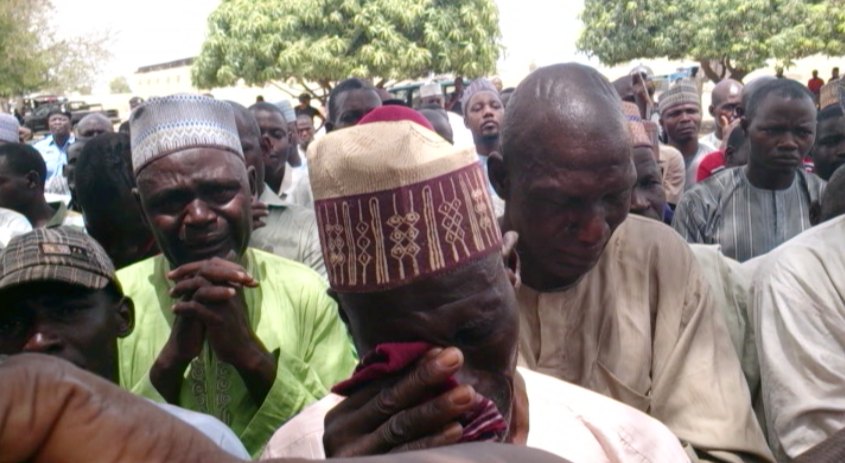
Picture: parents of the kidnapped girls at Chibok in the weeks after the abduction, April 2014. Voice of America, public domain, via Wikimedia Commons.
What happened at Chibok in 2014
Boko Haram, whose name is usually rendered "Western education is forbidden", had been attacking schools across the north-east for years. Chibok was different in scale. The attackers came in uniform, told the girls they were soldiers come to protect them, and marched them out. Fifty-seven jumped from the moving trucks or slipped away in the first hours and days, walking home through the bush. The other 219 vanished.
A month later the group's leader, Abubakar Shekau, released a video. "I abducted your girls," he said. "I will sell them in the market, by Allah." He said they would be married off. Later videos showed rows of girls in hijabs reciting the Quran. The girls were, almost all of them, Christians, many from families in the Ekklesiyar Yan'uwa a Nigeria, the Nigerian Church of the Brethren, whose heartland is that corner of Borno.
The Jonathan government's response was slow and defensive, and the Buhari government that followed it made bringing the girls home a campaign promise. Neither government ever launched a rescue of the main group. What brought girls home was escape, chance, and in the end a negotiated deal.
Who came home, and how
The first of the 219 to be found was Amina Ali Nkeki, in May 2016, walking out of the Sambisa forest with a baby and the man Boko Haram had married her to, discovered by local vigilantes. Then came the deals. In October 2016, after talks brokered by the International Committee of the Red Cross and the Swiss government, Boko Haram released 21 girls. In May 2017 it released 82 more, in exchange for a number of detained fighters.
That makes 103 released by negotiation, plus the 57 who fled on the first night. The rest have come home one or two at a time, across a decade, almost always by their own effort:
- Ruth Bitrus escaped in 2022, after eight years.
- Saratu Dauda escaped in 2023, and had to leave three children behind to do it.
- Lydia Simon was found by soldiers near Gwoza in April 2024, heavily pregnant and with three children. She had, over ten years, been married to three different fighters as each one died.
- Ihyi Abdu was rescued with a child in July 2024.
Each of these women spent years in the forest as a wife and a mother in a camp she had not chosen. None of them was rescued in the sense the hashtag imagined. The army found Lydia Simon because she was in a village it was already clearing. The others walked.
The ones who refused to come
When the 82 were released in 2017, the negotiators had been expecting 83. One girl refused to leave. "I have a husband," she told them. "I'm happy where I am." Ahmed Rufai, who headed Nigeria's foreign intelligence service at the time, later described sitting with a rescued girl who wanted to go back to her Boko Haram husband, and who said she had become a Muslim and that her Christian family would not understand.
This is the part of the Chibok story that is hardest to tell, and it needs telling honestly. Girls who were sixteen in 2014 are twenty-eight or twenty-nine now. Some have been in the forest for most of their adult lives. Some have four children there. Some were pressured into conversion and marriage so early and so thoroughly that the forest is the only home they know. Asabe Goni, one of the first to escape, has spoken about the daily pressure to convert, and about girls who gave in to make the beatings stop. The United Nations committee on women's rights, reporting in September 2025, said at least 91 Chibok girls remained in captivity or unaccounted for, that those who escaped on their own received almost no help from the state, and that more than 1,400 Nigerian schoolchildren had been kidnapped since Chibok.
Whether a girl stays because she is held, or stays because she has nowhere else she can imagine going, she is not free. The church has never stopped counting her.
Twelve years: the parents' letter
On the twelfth anniversary this April, the parents of the missing girls wrote an open letter to President Tinubu. Yana Galang, whose daughter Rifkatu is still missing, and Zanna Lawan, who has lost both a daughter and his own health to the years of waiting, put the number of their children still gone at 87. The Murtala Muhammed Foundation, which has worked with the Chibok families since 2014, counts 89 and noted that there had been no confirmed recovery in the previous year. The small gap between the figures is itself a verdict: no official list has ever been reconciled with the families'.
There has been good news of another kind. In May 2026, twelve of the Chibok survivors graduated from the American University of Nigeria in Yola, which took the released girls in and schooled them from the ground up. Twenty-one more are due to graduate next year. In August the federal government held a ceremony for eighteen who had completed vocational training. The girls who came home have, many of them, become nurses, teachers and lawyers. That is what the Chibok parents wanted for all 276 of them in 2014.
The video going round this week
On 6 November a post on X, shared tens of thousands of times, claimed that a Chibok girl had just escaped from Boko Haram with her children after twelve years. The clip shows a young woman in a hospital bed, a baby, and an interview in Hausa.
The footage is real, but it is not new. It is from April and May 2024 and shows Lydia Simon, the Chibok girl found near Gwoza with three children, being interviewed after her rescue. A page calling itself New Africa Network recaptioned it as a fresh escape, and others passed it on. No newspaper in Nigeria, no wire service and no aid agency has reported a Chibok escape this month.
There was a rescue on 2 November, and it is being confused with Chibok. Soldiers in the Gwoza area freed Hajara Haruna, a sixteen-year-old who had been taken from her village and held by Boko Haram. She was a child when Chibok happened. She is not one of the Chibok girls.
We say this not to take the air out of anyone's hope but because the Chibok families have been given false hope before, and because a church that prays for the missing by name ought to know who is actually missing. If one of the 87 does walk out of the forest, we will report it, with her name.
The church that was emptied
Chibok's Christians are poor, rural and, in the north-east, outnumbered. The EYN, the Church of the Brethren, lost pastors, congregations and whole villages to Boko Haram in the years around the kidnapping. Its prayer for the girls has never been a campaign. It has been Sunday after Sunday, in Chibok and in the displaced-persons camps and in Jos and Abuja where the families fled, for twelve years, with a list.
One of the girls released in 2016 told reporters how the group had kept its faith in the forest: "We continued praying when they are not around us." That sentence is the whole story of Chibok as the church sees it. Girls forced to recite another faith by day prayed to Jesus in whispers at night, and some of them came home still praying.
Jeremiah heard Rachel weeping for her children in Ramah and refusing to be comforted, and the Lord's answer was not that she should stop weeping but that her weeping was work, and that the work had a reward: "they shall come back from the land of the enemy." The church in Chibok has taken that promise literally for twelve years. It may yet be answered one girl at a time. It may be answered only in the resurrection. The parents' letter asked the president to do his part. The rest of us can at least keep the number, 87, and keep praying.
Related reading: The record of two silences: Nigeria's press and government and the killing of Christians, Liatu Samuel Dawa: the Borno mother jailed for fourteen years, and our Harvest section.
Questions this article answers
How many Chibok girls are still missing in 2026?
The parents of the missing girls put the number at 87 in their April 2026 letter to President Tinubu. The Murtala Muhammed Foundation, which works with the families, counts 89, and a UN committee said in 2025 that at least 91 were in captivity or unaccounted for. No official list has ever been reconciled with the families' own.
Did a Chibok girl escape in November 2026?
No. The video shared on X on 6 November 2026 is footage of Lydia Simon, who was found near Gwoza with three children in April 2024. It was recaptioned as a fresh escape. The girl rescued on 2 November 2026, Hajara Haruna, is sixteen and was not one of the Chibok girls.
How did the Chibok girls who came home get out?
Fifty-seven fled in the first hours in 2014. Twenty-one were released in October 2016 and 82 in May 2017 after talks brokered by the Red Cross and Switzerland. The rest have escaped or been found one at a time, often with children born in captivity, as recently as 2024.
Were the Chibok girls Christians?
Almost all of them. Chibok is a mostly Christian town and many of the families belong to the Ekklesiyar Yan'uwa a Nigeria, the Church of the Brethren. Boko Haram pressured the girls to convert and married many of them to fighters, and some who came home said they kept praying to Jesus in secret.
Why would a Chibok girl refuse to come home?
When 82 girls were freed in 2017 one stayed, saying she had a husband and was happy. Girls taken at sixteen are nearly thirty now, some with several children and a decade of forced conversion and marriage behind them. Whether held by force or by fear of what return would mean, they are not free, and the church still prays for them by name.