A false balance is an abomination to the LORD, but a just weight is his delight. (Proverbs 11:1)
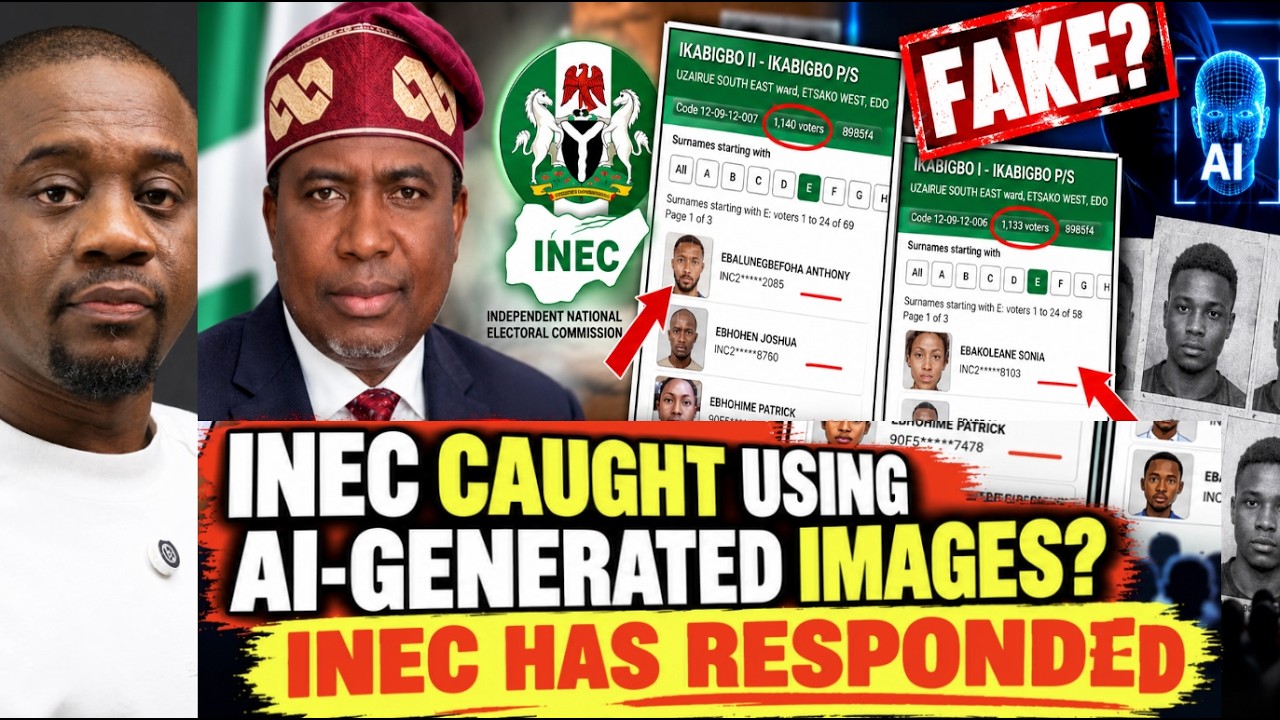
On Monday 26 October 2026 Nigeria's Independent National Electoral Commission (INEC) put its preliminary register of voters online for the first time, after weeks of pressure from opposition figures and civil society and after missing the deadline the Electoral Act set for it. Within a day Nigerians were passing round screenshots from the new portal of voter records in Edo State whose photographs, they said, were not photographs of anyone: smooth, symmetrical, oddly lit faces of the kind produced by artificial intelligence. By Tuesday evening INEC had issued a statement admitting that "suspicious photographs" were in the register and promising an investigation.
The video below, from the Nigerian commentary channel DonAza, walks through the screenshots and INEC's reply. This article sets out what has actually been established, what INEC has and has not said, why the register matters for the 2027 elections, how to check your own record before the final list is certified on 15 December, and how a Christian should think about it.
Video: "After Nigerians Caught INEC for Using AI Pictures, INEC Has This To Say", DonAza on YouTube.
What the Edo screenshots showed
The alarm was raised on X by a property and housing advocate who posts as Decosule (@SuleDeco). He shared screenshots from INEC's display portal of voter records from several polling units in Ward 11 of Etsako West local government area, Edo State. Each record carried a name, a voter identification number and a photograph, and it was the photographs that drew attention: a run of faces with the glossy, airbrushed look that AI image generators produce, with none of the ordinary blur, shadow or background of a registration-centre photo. He said he had seen similar images in the register for Udomi in Esan Central, the home council of Governor Monday Okpebholo, and he put three questions to INEC: who inserted the images, who captured them, and whether permanent voter cards had been collected for those entries.
Other users added complaints of their own. One, posting as @Onye_e, went through the list for his own polling unit of 1,432 voters and said he found more than 20 people who had died still on it, including one who died more than twelve years ago. Others reported duplicate records that appeared to show the same person registered more than once and, in at least one widely shared account, a voter who found a record with their own personal details and National Identification Number but a different photograph and gender, while their own name was missing from the online list. Nigerians abroad said they could not open the portal at all, and one user posted a screen reading "You've reached a viewing limit", asking INEC "how can you put a limit on the viewing of the register?"
Two cautions are in order. No independent expert has yet examined the images, so "AI-generated" is a strong suspicion rather than a finding. And a wrong or suspicious photograph on a record does not by itself show how it got there: deliberate fraud, a registration officer's shortcut, a software fault and a data-migration error would all look the same on a screenshot.
What INEC says
INEC's statement came on Tuesday 27 October, signed by Mohammed Kudu Haruna, the chairman of its Information and Voter Education Committee. Its main points:
- The register published online on 26 October is the same preliminary register that was physically displayed at registration areas across the country from 9 to 15 October, for the "display, claims and objections" exercise required by the Electoral Act.
- Some "questionable registration records" were identified and flagged for further examination during that physical display, and a review and corrective process was already under way.
- The online copy is the original preliminary register and "did not incorporate all ongoing data-cleanup activities". It is not the final certified register.
- The commission is investigating "the circumstances surrounding the suspicious photographs, including possible technical or procedural lapses that may have contributed to their appearance in the register", and will act "based on verified findings".
- It thanked the citizens who raised the alarm, saying public scrutiny is "essential to improving the accuracy and integrity of the voters' register", and restated that the final register of voters will be certified on 15 December 2026.
That is a more candid reply than INEC's critics expected, and it concedes the central point: the pictures are suspicious and should not be there. What it does not do is say how many records are affected, where else they appear, who captured them, or whether the entries have been used to collect voter cards. Until it does, the questions Decosule asked remain open.
Why people are angry
The reaction was sharp because the register is the foundation of the 2027 general election, and because trust in INEC is low after 2023. Professor Pat Utomi, the political economist and a leading figure in the opposition Nigeria Democratic Congress, shared the Edo images, which BusinessDay confirmed were on INEC's own website, and wrote: "INEC cannot afford to be careless with the credibility of Nigeria's electoral process. The presence of AI-generated images in a register meant to support our democracy raises serious questions about verification, transparency and accountability. Our democracy is at stake here!" His party had already accused INEC of planning to use artificial intelligence to tilt 2027 toward the ruling party, which INEC denies. Some users demanded the resignation of the INEC chairman, Professor Joash Amupitan. Others pointed out, fairly, that the suspicious entries came to light precisely because INEC published the register, which is the system working as intended.
The irony was not lost on anyone that Amupitan had spent September warning about artificial intelligence from the other direction. "Algorithms will not, and must never, decide the 2027 vote," he told a forum on AI and democracy, warning that deepfakes could be used to "hack voters' minds". The register episode shows the threat can come from inside the data as well as from outside propaganda.
The bigger clean-up
The suspicious photos are the most eye-catching symptom of a problem INEC has acknowledged for months. In February 2026 Amupitan listed what was wrong with the register: duplicate registrations, under-age registrants, non-citizens, dead voters, and incomplete or inaccurate records. The continuous voter registration that closed this year added about 10.8 million new registrants, a figure INEC itself says is subject to final biometric de-duplication. In July the commission signed up with the National Identity Management Commission to use the national identity database to find duplicates, and before the Ekiti governorship election in June it struck out 2,103 double registrations in that one state alone.
The display and objections period is the legal mechanism for catching what the machines miss: citizens look at the list, challenge entries that should not be there, and ask for their own missing or wrong records to be corrected. Publishing the list online, which INEC resisted and then did, multiplies the number of eyes on it. The Edo screenshots are the first fruit of that.
How to check your own record
Any registered voter can look themselves up on INEC's display portal at display.inecnigeria.org, by state, local government and registration area, or by voter identification number. Check that your name, photograph and polling unit are right. If your record is missing or wrong, or if you see entries at your polling unit that are plainly false, you can file a claim or objection through INEC's state office or the registration area officer; INEC says it is still processing claims and objections ahead of certification. Church groups, which already organise voter registration drives in many states, are well placed to help members do this before 15 December.
How a Christian should read this
Scripture has a great deal to say about honest records and honest weights, and none of it is neutral. "A false balance is an abomination to the LORD" (Proverbs 11:1). God's law forbids false witness and the bribe that "blinds the clear-sighted and subverts the cause of those who are in the right" (Exodus 23:8). An election register padded with people who do not exist is a false balance on a national scale, and believers should want it exposed and corrected whichever party benefits.
That means three things. First, take the suspicion seriously but hold it to the standard of evidence: the Bible warns against believing a report before it is examined (Proverbs 18:17), and INEC's statement deserves to be judged by what the investigation produces. Second, do the ordinary civic duty that is in front of you: check your own record, help the elderly and the less literate in your congregation to check theirs, and report what is wrong. Salt and light (Matthew 5:13-16) is a description of exactly this kind of patient, public honesty. Third, pray: for the INEC officials doing the review, for the staff who may have cut corners or worse, and for Nigeria's leaders and would-be leaders, "that we may lead a peaceful and quiet life, godly and dignified in every way" (1 Timothy 2:1-2). The country is heading into an election in which a fair count will matter more than any candidate. "When the righteous increase, the people rejoice" (Proverbs 29:2), and a righteous register is where that starts.
For more Nigerian news read in the light of Scripture, see our News section and our report on the JIBWIS member arrested for calling for rifles to kill Christians.
Questions this article answers
Did INEC use AI-generated photos in the voters' register?
INEC has admitted that "suspicious photographs", including some suspected to be AI-generated, appear in the preliminary register published online on 26 October 2026, and says it is investigating how they got there. It has not confirmed that the images were made by AI, nor said how many records are affected.
Where were the AI-looking photos found?
In screenshots of voter records from polling units in Ward 11, Etsako West local government area, Edo State, shared on X by the user Decosule (@SuleDeco), who said he saw similar images in Udomi, Esan Central. Other users reported duplicates, deceased relatives still listed and missing names elsewhere.
What did INEC say about the AI photos?
In a statement on 27 October signed by Mohammed Kudu Haruna, INEC said the online register is the same preliminary register displayed from 9 to 15 October, that questionable records were flagged during that display and are being reviewed, that the online copy does not include ongoing clean-up, and that it is investigating "possible technical or procedural lapses".
How do I check my name on the INEC voters' register?
Go to display.inecnigeria.org, choose your state, local government and registration area, or search by voter identification number, and confirm your name, photograph and polling unit. Report errors or false entries through INEC's state office before the final register is certified on 15 December 2026.
When will the final INEC register be ready for 2027?
INEC says it will complete verification, adjudication and data clean-up and certify the final register of voters on 15 December 2026.
Sources: INEC's statement of 27 October 2026 as reported by PRNigeria, BusinessDay, Leadership, The Cable, Vanguard, Techeconomy and Pulse Nigeria; the screenshots and questions posted on X by @SuleDeco and the reaction of Professor Pat Utomi as reported by Vanguard, Tribune and News Central; ThisDay and The Guardian Nigeria on the online publication of the register (26 October); INEC chairman Joash Amupitan's statements on the register (February 2026) and on AI and deepfakes (September 2026) as reported by AllAfrica, The Will and Politics Nigeria; Vanguard on the INEC-NIMC agreement (July 2026); The Eagle Online on the Ekiti de-duplication. The claim that the photographs are AI-generated has not been independently verified; this article will be updated when INEC reports its findings.