Remember them that are in bonds, as bound with them; and them which suffer adversity, as being yourselves also in the body. (Hebrews 13:3)
At ten to six on the evening of Thursday 4 September 2026, about fifty members of Beijing Jiaquan Church were in a hotel conference room in the capital, hanging decorations and setting out chairs. Their church was twenty years old that month, and they were getting ready to celebrate. Then more than a hundred police officers, in uniform and in plain clothes, surrounded the room. Seven of the people decorating it were taken away. Their pastor, Cui Xianfeng, was picked up elsewhere in the city the same evening.
On 23 October a Beijing prosecutor approved his formal arrest on suspicion of fraud. He is being held at the Shijingshan District Detention Centre. His wife, who is South Korean, has not been allowed into China to see him since 2023. His message to the church, passed out through the lawyers, was one sentence: hold fast to your faith and never lose hope.
This is the second of Beijing's large unregistered churches that the Chinese state has broken up in thirteen months, and the charge is the same one being used against the first: a government that will not let a church register now prosecutes it for taking an offering. Here is what is known, from the Associated Press, which spoke to his wife this week, and from ChinaAid, which has followed the case since the raid.
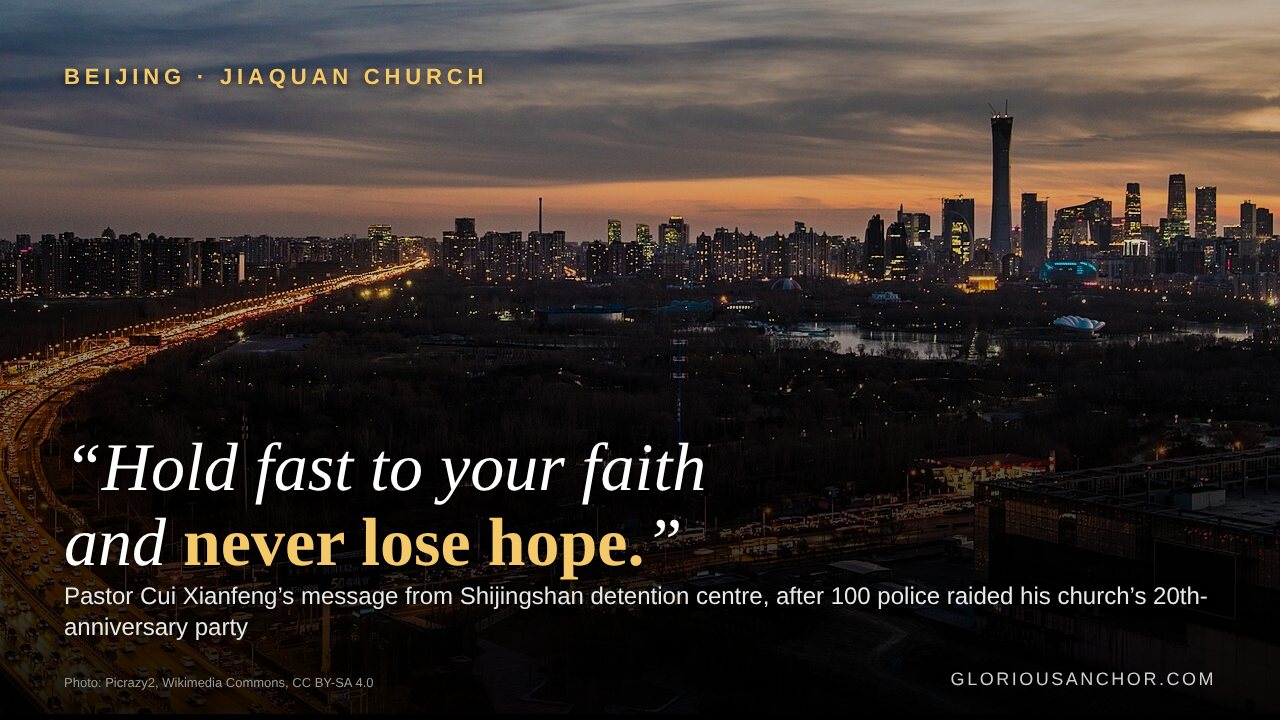
Picture: Beijing at dusk, with the words Pastor Cui Xianfeng sent out to his church from the Shijingshan detention centre. Photo: Picrazy2, Wikimedia Commons, CC BY-SA 4.0.
Twenty years, from Biola to Beijing
Cui Xianfeng is also known by his English name, Edward Cui, by the Korean form of his name, Choi Heonbong, and in church circles as Zhou Zixun. He and his wife, Cui Jinrong, married in 1997 and went to California the next year to study at Biola University, the evangelical school in La Mirada. When he graduated they went home. They returned to Beijing in late 2005 and in 2006 started a church, Jiaquan, with no state registration, which in China means no permission.
It grew. ChinaAid describes Jiaquan today as an independent house-church network of more than a thousand believers in several parts of China, outside the government's Three-Self Patriotic Movement, the only Protestant body the state recognises. Its leaders, ChinaAid says, "have maintained their independence from China's government-controlled Protestant religious system." That independence is the whole of the offence.
The pressure came in stages. In 2019 the authorities sealed the church's worship hall in Beijing, and the congregation did what Chinese house churches have done for seventy years: it broke into small groups and met in homes and borrowed rooms at different addresses. In 2023 officers walked into a Sunday class and told the couple, in front of the students, that their church had become too large. "They told him that he should lead only one church with fewer than 100 people," Mrs Cui told the AP. "This was a direct warning from the authorities concerning the size and organization of our church." The same year her visa applications began to be refused. She is a Korean citizen and has asked to enter China as a family member; she has been turned down for three consecutive years.
The raid, and the charge
The anniversary was the occasion the authorities chose. After the raid on 4 September, eight Christians were held in criminal detention: the seven taken from the hotel, Cui, and, a few days later, two more church leaders, after two of the original seven were let go. On 23 October, the day Cui's arrest was approved, the other seven were released on bail. Mrs Cui says they came out with "physical and psychological trauma" from the interrogations. Other members, she says, are still being called in for questioning.
The charge is fraud, and it concerns the offering. The authorities have published no evidence. Mrs Cui's answer is that the "fraud" is nothing more than the collection and use of church members' gifts by a church the state refuses to register, so that every yuan of it, in the state's eyes, was taken under false pretences. The police in Shijingshan district and the Foreign Ministry did not answer the AP's questions.
On 27 October she issued a public statement. Jiaquan, she said, will remain an independent house church "guided by biblical teachings and historical Christian traditions". It has no political aims and no quarrel with the secular authorities, and she asked officials to recognise what Christianity contributes to "family harmony and social stability". She asked the church in China and abroad for prayer, for her husband's health, and for the seven who had just come out. The defence team is preparing to seek his release and the acquittal of all eight.
The second church in thirteen months
Jiaquan's story only makes sense beside Zion's. On the night of 10 October 2025, police in eleven cities moved at once against Beijing Zion Church, the capital's largest unregistered congregation, founded in 2007 by Pastor Jin Mingri, known as Ezra Jin, and grown to around 1,500 people before its sanctuary was shut in 2018. Nearly thirty leaders were taken that night. Christianity Today has told the story of one of them: Ren Zhong, a Zion minister, watching seven plainclothes officers break down his door, take his wife, Pastor Wang Cong, into another room and lead her away, and then running into the rain after the police car with their three-year-old daughter in his arms so that the child would not lose hope.
Eighteen of the Zion leaders were formally arrested. The first charge was "illegally using information networks", for broadcasting sermons online. By June 2026 the charges against the remaining prisoners had been changed to "illegal business operations" and "fraud". On 3 July, after President Trump raised his case personally with Xi Jinping, Jin was taken from his cell to the airport and flown to Los Angeles. Eight of his colleagues are still in prison, Pastor Wang Cong among them, five of them charged with fraud.
So when the police came for Jiaquan's anniversary party seven weeks later and the prosecutor wrote "fraud" on the warrant, they were not improvising. The offering plate has become the state's chosen instrument against the house churches: it turns worship into a business, givers into victims, and a pastor into a swindler, and it needs no law about religion at all.
What it means, and how to pray
China's Christians have lived under this since 1949, and the house churches, by most estimates tens of millions strong, are larger today than at any time in the country's history. They did not grow by registering. Pastor Jin's op-ed from Los Angeles, written for the colleagues he left in Beihai's detention centres, said they "are confined in cramped cells and sleep on floor mats in blistering heat", and that he would not rest until they were free. Ren Zhong, whose wife is one of them, put the case in the terms Scripture uses: "It involves two forces, the forces hostile to God and the forces that believe in God, and they will inevitably clash. God is fighting this battle."
For the church outside China the instructions are old ones. "Remember them that are in bonds, as bound with them." Pray for Cui Xianfeng in Shijingshan, by name; for Cui Jinrong, three years from her husband and waiting on a visa; for the seven who came home from interrogation; for Wang Cong, Wang Lin and the six others of Zion still held; and for the officers who did the arresting, because Paul was one of those once. And take the pastor's own word as the church's: hold fast, and never lose hope.
Related reading: The record of two silences: Nigeria's press, government and the killing of Christians, Liatu Samuel Dawa: the Christian mother jailed in Borno, and our News section.
Questions this article answers
Who is Pastor Cui Xianfeng and what is Beijing Jiaquan Church?
Cui Xianfeng, also called Edward Cui, Choi Heonbong and Zhou Zixun, founded Beijing Jiaquan Church in 2006 with his wife after studying at Biola University in California. It is an unregistered house-church network of more than a thousand believers in several parts of China, independent of the state-controlled Three-Self church.
When and why was Pastor Cui arrested?
He was detained on 4 September 2026 when more than 100 police raided a hotel room where church members were preparing the church's twentieth-anniversary celebration, and formally arrested on 23 October 2026 on suspicion of fraud relating to church offerings. His wife says the charge arises only from the church's unregistered status. He is held at Shijingshan District Detention Centre, Beijing.
What happened to the others detained with him?
Eight Christians were held in criminal detention after the raid. Seven were released on bail on 23 October, the day Cui's arrest was approved; his wife says they suffered physical and psychological trauma in interrogation and that other members are still being questioned.
How is the Jiaquan case connected to Beijing Zion Church?
Zion Church, Beijing's largest house church, was raided across eleven cities on 10 October 2025 and nearly thirty leaders detained. Its founder Jin Mingri was released to the United States on 3 July 2026 after President Trump's intervention, but eight leaders remain in prison, most charged with fraud, the same charge now used against Cui.
How can Christians pray for the church in China?
By name: for Cui Xianfeng's health and release, for his wife Cui Jinrong to be allowed into China, for the seven released on bail, for the eight Zion leaders still imprisoned, and for the officials and officers involved. Hebrews 13:3 asks the church to remember prisoners as if bound with them.