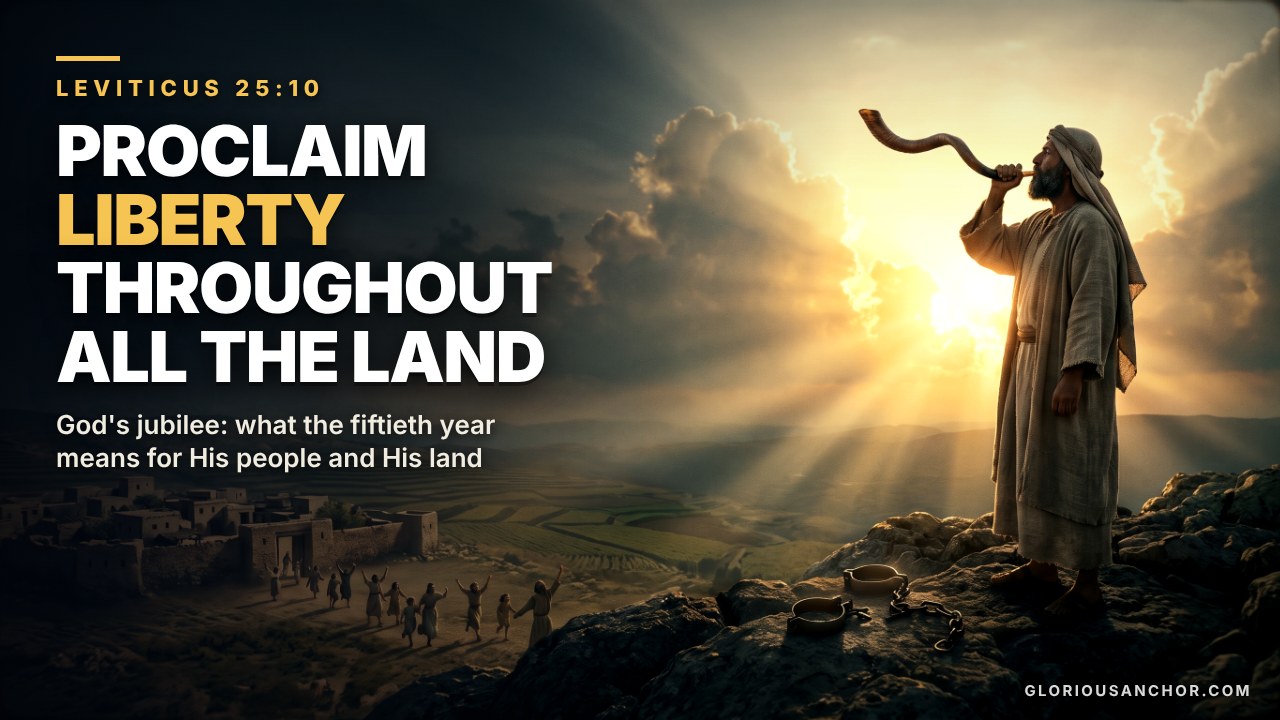
And ye shall hallow the fiftieth year, and proclaim liberty throughout all the land unto all the inhabitants thereof: it shall be a jubile unto you; and ye shall return every man unto his possession, and ye shall return every man unto his family. (Leviticus 25:10)
Once in every fifty years, on the Day of Atonement, a ram's horn was to sound through the whole land of Israel, and everything that poverty and debt had pulled apart was to be put back together. The man who had sold himself went home to his family. The field that had been sold in a hard year went back to the family God first gave it to. The soil itself was left to rest. God called that year the jubilee.
It is one of the least preached laws in the Bible and one of the most important, because when Jesus stood up in Nazareth to say what He had come to do, it was the jubilee He announced.
This article sets out what the jubilee was, why God commanded it, what became of it in Israel, how it is fulfilled in Christ, and what it means today for His people and for His land.
What is the jubilee in the Bible?
God gave Israel a sabbath of days and a sabbath of years. Six years the land was sown and the seventh it rested (Leviticus 25:1–7). Then He told them to count "seven sabbaths of years", forty-nine years, and to set the next one apart:
Then shalt thou cause the trumpet of the jubile to sound on the tenth day of the seventh month, in the day of atonement shall ye make the trumpet sound throughout all your land. (Leviticus 25:9)
The word comes from the Hebrew yobel, the ram's horn that announced it. The King James Version spells it "jubile". It was not a custom Israel invented or a festival of thanksgiving for a good harvest. It was law, given by God at Sinai (Leviticus 25:1), and it was built into the nation's calendar so that it would come whether anyone wanted it or not.
Its best-known sentence, "Proclaim liberty throughout all the land unto all the inhabitants thereof", is cast in the metal of the Liberty Bell in Philadelphia.
The four provisions of the jubilee: liberty, return, release and rest
- Liberty for the bound. An Israelite who fell into poverty and sold himself was to be treated as a hired worker and not as a slave, "and shall serve thee unto the year of jubile: And then shall he depart from thee, both he and his children with him, and shall return unto his own family" (Leviticus 25:40–41).
- Return of property. Land sold in hardship went back to the family that had inherited it: "In the year of this jubile ye shall return every man unto his possession" (Leviticus 25:13). What a buyer paid for was never the land itself, only the number of harvests left until the jubilee (25:15–16).
- Release from debt. Every seventh year was already "the LORD's release", when a creditor let go what he had lent his neighbour (Deuteronomy 15:1–2). The jubilee followed the seventh of those years and finished the work: the land that had been lost to debt and the people who had been sold because of it both went free. Nobody could be made poor for ever.
- Rest for the land. "Ye shall not sow, neither reap that which groweth of itself in it" (Leviticus 25:11). To the obvious question, what shall we eat, God gave His answer in advance: "I will command my blessing upon you in the sixth year, and it shall bring forth fruit for three years" (25:21).
Running through all four is one command about how God's people treat each other: "Ye shall not therefore oppress one another; but thou shalt fear thy God" (25:17).
Why God commanded it: "the land is mine"
Two sentences carry the whole chapter.
The land shall not be sold for ever: for the land is mine; for ye are strangers and sojourners with me. (Leviticus 25:23)
For they are my servants, which I brought forth out of the land of Egypt: they shall not be sold as bondmen. (Leviticus 25:42)
The jubilee is not first about economics. It is about ownership. The land belongs to God and the people belong to God, so no sale of either can ever be final, because the seller never held them outright. Israel were tenants on His ground and servants in His house.
Every fifty years God asserted His title. Whatever had slipped into the wrong hands, whether by misfortune, by folly or by another man's greed, went back to where He had placed it. The jubilee is God saying of His land and His people: these are still mine.
The kinsman-redeemer: nobody had to wait fifty years
The jubilee was the last resort and not the only one. A near relative could step in at any time and buy back what had been lost:
If thy brother be waxen poor, and hath sold away some of his possession, and if any of his kin come to redeem it, then shall he redeem that which his brother sold. (Leviticus 25:25)
The same held for a person who had sold himself (25:47–49). The jubilee was for the one who had no redeemer: "if he be not redeemed in these years, then he shall go out in the year of jubile, both he, and his children with him" (25:54). This is the law Boaz kept when he redeemed the inheritance of Naomi's family and took Ruth as his wife (Ruth 4). Keep the kinsman-redeemer in mind. He comes back.
Why the jubilee began on the Day of Atonement
The fiftieth year was not announced on New Year's Day. The trumpet sounded on the tenth day of the seventh month, the one day in the year when the high priest carried blood into the holiest place for the sins of the whole nation (Leviticus 16).
The order matters. First sin was dealt with before God, and then liberty was proclaimed to men. There was no jubilee without atonement. That has not changed.
The jubilee Israel did not keep
Scripture does not record a single jubilee that Israel kept. It records what happened instead.
God had warned that a land refused its rest would take that rest anyway: "Then shall the land enjoy her sabbaths, as long as it lieth desolate, and ye be in your enemies' land" (Leviticus 26:34). The seventy years in Babylon were the bill coming due: "until the land had enjoyed her sabbaths: for as long as she lay desolate she kept sabbath, to fulfil threescore and ten years" (2 Chronicles 36:21).
In Jeremiah's day, with the Babylonian army at the walls, the nobles of Jerusalem set their Hebrew slaves free, and when the siege eased they took them back. God answered in the jubilee's own words:
Ye have not hearkened unto me, in proclaiming liberty, every one to his brother, and every man to his neighbour: behold, I proclaim a liberty for you, saith the LORD, to the sword, to the pestilence, and to the famine. (Jeremiah 34:17)
After the exile, Nehemiah found the same sin again, nobles holding the fields, the vineyards and the children of their own brethren for debt, and made them give it all back in a day (Nehemiah 5:1–13).
The lesson is plain. God's release and God's rest are not optional. A people who will not give them will see them taken.
So the prophets began to look for a greater jubilee and for someone who would bring it:
The Spirit of the Lord GOD is upon me; because the LORD hath anointed me to preach good tidings unto the meek; he hath sent me to bind up the brokenhearted, to proclaim liberty to the captives, and the opening of the prison to them that are bound; To proclaim the acceptable year of the LORD. (Isaiah 61:1–2)
"Proclaim liberty" is the phrase of Leviticus 25:10. "The acceptable year of the LORD" is the jubilee. Ezekiel calls it simply "the year of liberty" (Ezekiel 46:17).
Jesus and the jubilee: "This day is this scripture fulfilled"
Jesus came to Nazareth, where He had been brought up, went into the synagogue on the sabbath and stood up to read. He was handed the book of Isaiah, found the place, and read:
The Spirit of the Lord is upon me, because he hath anointed me to preach the gospel to the poor; he hath sent me to heal the brokenhearted, to preach deliverance to the captives, and recovering of sight to the blind, to set at liberty them that are bruised, To preach the acceptable year of the Lord. (Luke 4:18–19)
Then He closed the book, sat down, and said: "This day is this scripture fulfilled in your ears" (Luke 4:21).
Three things stand out.
- He stopped in the middle of the sentence. Isaiah goes on: "and the day of vengeance of our God". Jesus closed the book before those words. The acceptable year has come; the day of vengeance has not yet. We are living in the space between the two, which is why Paul writes, "behold, now is the accepted time; behold, now is the day of salvation" (2 Corinthians 6:2).
- He is the kinsman-redeemer. Only a near relative could redeem, so the Son of God took flesh and blood and became our kinsman, "that through death he might destroy him that had the power of death, that is, the devil; And deliver them who through fear of death were all their lifetime subject to bondage" (Hebrews 2:14–15). In Him "we have redemption through his blood, the forgiveness of sins" (Ephesians 1:7).
- His jubilee also begins with atonement. The cross is the Day of Atonement that the first one only pictured: "by his own blood he entered in once into the holy place, having obtained eternal redemption for us" (Hebrews 9:12). Liberty is proclaimed because the blood has been shed.
The jubilee, then, is not first a year. It is a Person. The Spirit of the Lord was upon Him to bring it, and the same Spirit is given to the church to carry it.
What the jubilee means for His people
- Liberty. "If the Son therefore shall make you free, ye shall be free indeed" (John 8:36). Free from the rule of sin (Romans 6:14), from the fear of death, and from every yoke the enemy claims a right to lay on you. "Stand fast therefore in the liberty wherewith Christ hath made us free" (Galatians 5:1).
- Debt cancelled. He has blotted out "the handwriting of ordinances that was against us, which was contrary to us, and took it out of the way, nailing it to his cross" (Colossians 2:14). The debt of sin has not been rescheduled. It has been wiped out. And forgiven people forgive: "forgive us our debts, as we forgive our debtors" (Matthew 6:12). The servant in Matthew 18 who took his fellow servant by the throat is a man who received a jubilee and refused to give one.
- Inheritance restored. What Adam sold, Christ has bought back: "an inheritance incorruptible, and undefiled, and that fadeth not away" (1 Peter 1:4), with the Holy Spirit as "the earnest of our inheritance until the redemption of the purchased possession" (Ephesians 1:14).
- A return to the family. "Ye shall return every man unto his family." The prodigal's road home is a jubilee road (Luke 15:20–24), and those who "were far off are made nigh by the blood of Christ" (Ephesians 2:13).
- Rest. In the jubilee Israel lived for a year on what God had already provided and not on what they could produce. That is a picture of grace. "There remaineth therefore a rest to the people of God" (Hebrews 4:9).
- A new owner. "Ye are bought with a price; be not ye the servants of men" (1 Corinthians 7:23). The liberty of the jubilee is not independence. The freed Israelite went out from his master because he belonged to God, and so do we.
The first church lived like people in a jubilee: "Neither was there any among them that lacked" (Acts 4:34).
What the jubilee means for His land
"The land is mine" was said of Canaan, but Scripture does not leave it there: "The earth is the LORD's, and the fulness thereof; the world, and they that dwell therein" (Psalm 24:1). Every nation lives on God's ground as a tenant. From that, four things follow.
- A land can be defiled. What a people does on the land does something to the land. Idolatry, bloodshed and sexual sin defile it (Leviticus 18:25; Numbers 35:33; Psalm 106:38), and the land suffers for it.
- No other claim on it is permanent. Tenants may hand a land over to other gods, raise altars on it and make covenants over it, but they are disposing of what is not theirs. The principle of the jubilee is that the Owner sets a term on every hold but His own.
- A land can be healed. "If my people, which are called by my name, shall humble themselves, and pray, and seek my face, and turn from their wicked ways; then will I hear from heaven, and will forgive their sin, and will heal their land" (2 Chronicles 7:14). The order is the jubilee's order: atonement first, then release. And it begins with His people, not with the government.
- The last jubilee is coming. Creation itself "shall be delivered from the bondage of corruption into the glorious liberty of the children of God" (Romans 8:21). Peter calls it "the times of restitution of all things" (Acts 3:21). On that day the whole earth returns to its Owner.
How to keep the jubilee now
Christians are not under the calendar of Leviticus. Paul calls its holy days and sabbaths "a shadow of things to come; but the body is of Christ" (Colossians 2:17). The jubilee is not kept by counting years or by sounding a horn. It is kept by living and declaring what it pictured.
- Come by the atonement. Every jubilee starts at the blood. Confess sin, your own and, as Daniel and Nehemiah did, the sins of your people and your fathers (Daniel 9:4–19; Nehemiah 1:6).
- Proclaim it. Liberty in Leviticus was never automatic and never silent. It had to be proclaimed "throughout all the land". The trumpet of the jubilee today is the gospel preached and the church at prayer, declaring over lives, families and nations what Christ has done.
- Release. Forgive what you are owed. Drop the grudge. Where you have the power to lift a burden from someone, lift it.
- Restore. When the jubilee reached the house of Zacchaeus he said, "if I have taken any thing from any man by false accusation, I restore him fourfold" (Luke 19:8). Give back what is not yours.
- Rest. Stop striving to earn what has been given, and trust the God who commanded a blessing in the sixth year.
A fiftieth year: why we are writing about this now
This site has been telling the story of FESTAC 77, the festival at which, from 15 January to 12 February 1977, Nigeria played host to the gods of many nations in the nation's own name. Fifty years from its close will be complete on 12 February 2027. Our account argues that the festival worked like a lease on the land, traces what the country was before it and after it, and tells it as a film, Nigeria: The Lease, which is in the article and on GAIN TV.
The jubilee is why that date matters. The Owner of the land has not surrendered His title, and He sets a term on every other claim. But no date sets anyone free by itself. In Leviticus the fiftieth year arrived with atonement and a proclamation, and where Israel offered neither, nothing was released. The people of God have to do what the jubilee always required of them: confess, and then proclaim.
What is true of one nation is true of any nation, any family and any life. Whatever of yours has been in the wrong hands, however long it has been there, God has not given up His claim to it. The acceptable year of the Lord has been announced, and it is still open.
Sources
- Leviticus 25 and 26, Deuteronomy 15, 2 Chronicles 36, Jeremiah 34, Nehemiah 5, Isaiah 61 and Luke 4 are the chief passages. Scripture quotations are from the King James Version, which spells the word "jubile".
- The inscription on the Liberty Bell: Wikipedia, Liberty Bell.
- Cover: an illustration made with AI.
Questions this article answers
What is the year of jubilee in the Bible?
It is the fiftieth year, which God commanded Israel to keep holy after every seven sabbaths of years (Leviticus 25:8–10). It was announced by a ram's horn on the Day of Atonement, and in it liberty was proclaimed throughout the land.
What happened in the year of jubilee?
Israelites who had sold themselves went free, land that had been sold returned to the family that inherited it, the hold of debt was broken and the soil rested for the year. God promised a harvest in the sixth year large enough to carry the nation through.
Was debt cancelled in the jubilee?
Debts were released every seventh year, which was called "the LORD's release" (Deuteronomy 15:1–2). The jubilee followed the seventh of those years and undid what debt had done: the land lost to it and the people sold because of it were restored.
What does "the land is mine" mean in Leviticus 25:23?
It means God is the owner and His people are tenants, "strangers and sojourners" with Him. That is why the land could not be sold for ever. Psalm 24:1 extends the same truth to the whole earth.
Did Israel ever keep the jubilee?
Scripture does not record one. It records the land taking its missed sabbaths during the seventy years of exile (2 Chronicles 36:21) and God's judgment on those who released their slaves and then took them back (Jeremiah 34:8–17).
How did Jesus fulfil the jubilee?
In Nazareth He read Isaiah's promise of liberty to the captives and "the acceptable year of the Lord", and said, "This day is this scripture fulfilled in your ears" (Luke 4:18–21). He is the kinsman-redeemer, and His cross is the atonement from which the liberty flows.
What does the jubilee mean for Christians today?
Freedom from sin's rule, a debt blotted out, an inheritance restored, a place in God's family and rest in His provision. It is kept by receiving these in Christ, proclaiming them, forgiving others and restoring what is owed.